 Painting
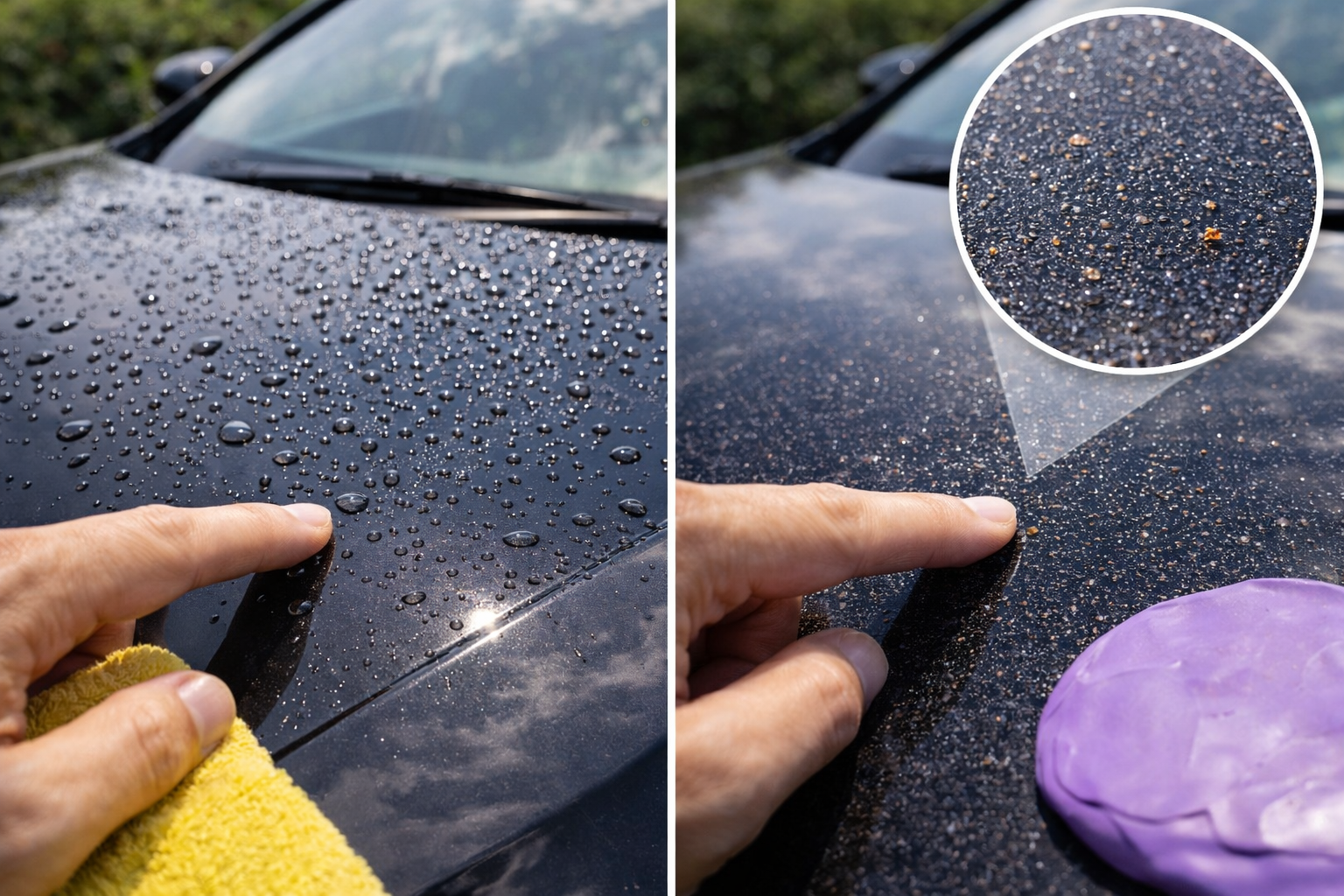
Many people experience the same situation: the car is washed and appears clean, but when the hand is passed over the paint, the surface feels rough. This uneven texture creates the impression that something is still wrong with the surface. In fact, in most cases there is a technical reason for this to happen.
Although washing removes a large portion of visible dirt, not all contaminants present on the paint are always eliminated. This happens because many particles adhere more deeply to the clear coat. As a result, even after a careful wash, the surface may remain contaminated.
For this reason, understanding why the car feels rough after washing is essential for maintaining the appearance, shine, and durability of the paint. In addition, when the correct cause is identified, the issue can usually be resolved with relatively simple processes.
What causes the rough feeling on the paint
First of all, it is important to understand that roughness is usually not caused by a lack of cleaning. In most situations, the issue is related to paint contamination.
During daily vehicle use, different types of particles are deposited on the surface. These particles can become embedded in the clear coat and cannot be removed with automotive shampoo alone.
Among the most common contaminants are:
These contaminants are often referred to as ferrous contamination or bonded contamination. Because they become embedded in the clear coat, they are not easily removed during conventional washing.
Consequently, when the hand is passed over the paint, the surface may feel rough even though it looks clean.
Why traditional washing does not remove this type of dirt
In general, automotive washing is designed to remove loose or superficial dirt. Dust, mud, light grease, and organic residues are typically removed easily when a proper automotive shampoo is used.
However, bonded contaminants behave differently.
These particles can be pressed against the clear coat due to factors such as:
Over time, these particles become embedded in the outer layer of the paint. As a result, they cannot be removed with just water, shampoo, or light scrubbing.
Therefore, even when the car is washed correctly, the rough texture may still be noticed.
How to identify if the car is contaminated
Fortunately, identifying this type of problem is usually quite simple.
One commonly used method among automotive detailing professionals is the touch test.
After the vehicle has been washed and dried, gently pass your hand over the paint surface. If the surface feels completely smooth, it means the paint is clean and decontaminated.
However, if small irregularities are felt — as if there were tiny bumps or grains — it is very likely that bonded contamination is present on the paint.
Another way to identify the issue is by placing a thin plastic bag over your hand. In this case, the sensitivity of touch increases significantly, allowing imperfections to be felt more easily.
This method is often used because the plastic amplifies the perception of irregularities.
How to solve the roughness problem on the paint
When contamination is confirmed, the most recommended solution is to perform a process called paint decontamination.
This process can be carried out in two main stages.
1. Chemical decontamination
First, chemical decontamination can be performed. In this stage, specific products are applied to dissolve contaminants present on the surface.
Among the most commonly used products are:
These products react with bonded particles, making their removal easier. In many cases, a color change can be observed during the chemical reaction, indicating that the contaminants are being dissolved.
As a result, a large portion of the contamination can be removed without the need for heavy friction.
2. Mechanical decontamination
After chemical decontamination, the mechanical stage is usually performed.
In this process, a clay bar (decontamination clay) is used together with a suitable lubricant. The clay slides over the surface and removes particles that remain attached to the clear coat.
During this procedure, microscopic contaminants are captured by the clay, gradually leaving the surface smoother.
When the process is completed correctly, the paint typically presents a completely smooth feel to the touch.
Benefits of paint decontamination
In addition to solving the rough texture problem, decontamination offers several benefits for the vehicle’s paint.
Among the main benefits are:
Better paint gloss When the surface is clean and free of contaminants, light reflection becomes more uniform.
Greater efficiency of waxes and sealants Protection products adhere better when the paint is decontaminated. To ensure this process is effective, we recommend Native Cleaner Wax Vonixx.
Reduced risk of scratches Bonded contaminants can create micro-scratches during washing. Once they are removed, this risk is reduced.
Improved overall vehicle appearance The paint begins to show a smoother texture and a deeper visual finish.
How often decontamination should be performed
The ideal frequency may vary depending on how the vehicle is used.
Cars driven in large urban centers or industrial regions tend to accumulate contamination more quickly. Likewise, vehicles that frequently travel on highways may be exposed to higher levels of metallic particles and pollutants.
In general, it is recommended that paint decontamination be performed two to four times per year, depending on usage conditions.
However, this interval may vary according to the environment and the maintenance practices applied to the vehicle.
How to prevent the paint from becoming rough again
After the paint has been decontaminated, some practices can help keep the surface smooth for longer.
These include:
When the surface is protected, the adhesion of contaminants tends to be reduced.
In addition, proper maintenance makes future washes easier and helps preserve the shine of the paint.
Conclusion
The rough feeling on the paint, even after washing the car, is a very common issue. However, in most cases it is not related to incorrect washing, but rather to the presence of contaminants bonded to the clear coat.
These particles are not removed during traditional washing and remain on the paint surface. As a result, the irregular texture can be felt when the surface is touched.
Fortunately, the problem can be solved with chemical and mechanical decontamination processes. When these procedures are performed correctly, the surface returns to a smooth and uniform texture.
Moreover, keeping the paint protected and performing periodic maintenance helps preserve the vehicle’s finish and prevents roughness from appearing again.
Sign up to receive useful tips and content.